

For years, marketers have used the language of values and purpose interchangeably. It’s a well-intentioned blur, but one that has caused real confusion. Too often, Values-Driven Marketing (VDM) is mistakenly grouped with cause-based or nonprofit marketing. The truth is, they’re fundamentally different disciplines.
Values-Driven Marketing isn’t about what a brand believes—it’s about what people believe, and how those beliefs shape decisions, preferences, and performance.
At Aletheia, we see VDM as a marketing science built on measurable human motivation, not moral positioning. Our latest WARC + Aletheia research confirmed what we’ve known through years of client work: when you align your audience, message, and media with the values that matter most to people, advertising performs better across every metric that counts.
The Behavioral Science Behind “Values”
Behavioral Science defines values as what matters most to someone in life—concepts like Tradition, Achievement, Freedom, or Security that drive how people think, feel, and act.
These values are not moral codes or ESG principles. They’re motivational drivers that operate below the surface of awareness, influencing what people notice, prefer, and purchase. In the words of psychologist Shalom Schwartz, values form an “ordered system of priorities” that guides our behavior across contexts and cultures.
Understanding these drivers lets marketers predict what will resonate emotionally and perform commercially. As WARC’s research found, campaigns using Values-Driven Marketing produced uplifts in ad preference of up to +23 points and click-through rates up to 2× higher than traditional demographic targeting.
What Values-Driven Marketing Is
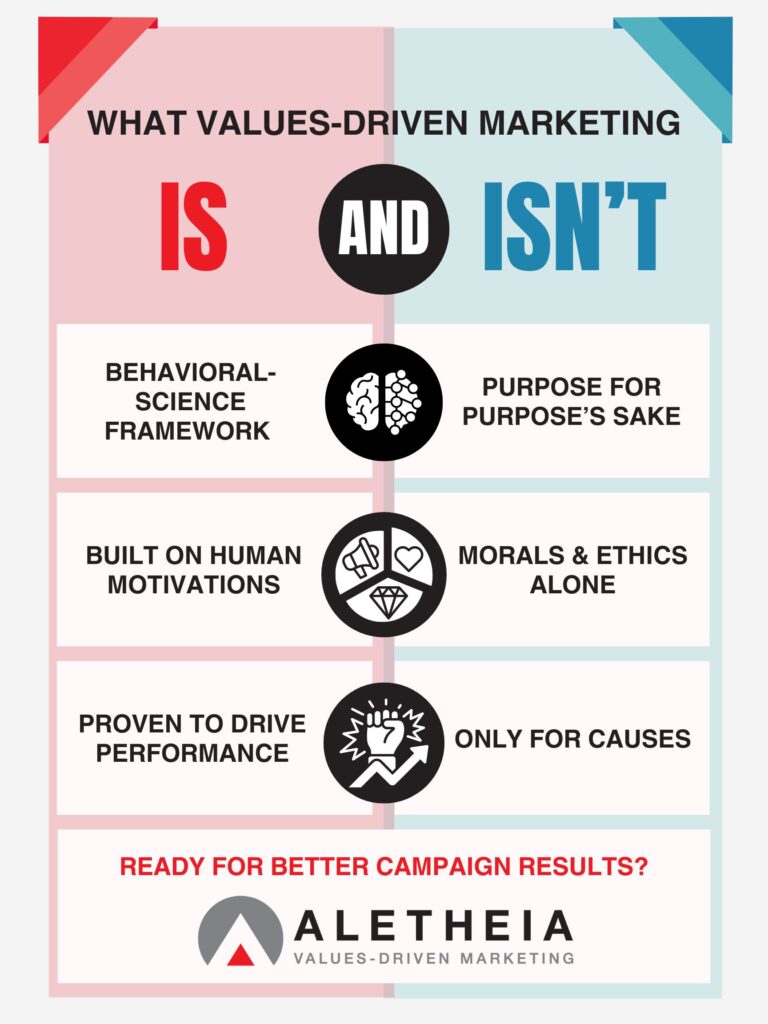
Values-Driven Marketing is a that links audience intelligence, creative strategy, and media activation around the motivations that drive human behavior.
Using AI-powered tools like Pluralytics and Zenzi Audiences, Aletheia identifies the six dominant ValuesTypes—Pleasure, Tradition, Security, Purpose, Achievement, and Freedom—and maps which combinations best align with a brand’s category and growth goals.
Those insights are then used to:
- Define audiences more precisely than demographics or lifestyle segments.
- Shape messaging that speaks to underlying motivations, not surface preferences.
- Select media environments that reinforce those motivations in context.
The result is creative and placement synergy. Effective ads feel right to the audience because they reflect their inner compass.
What It Isn’t
Values-Driven Marketing is not:
- A moral stance or corporate purpose campaign.
- A cause-only or nonprofit communications strategy.
- A branding exercise divorced from performance.
The WARC + Aletheia study draws a clear distinction: values are predictors of behavior, not declarations of belief. Brands don’t have to claim a social mission, they just need to understand what motivates their customers and connect authentically.
As Amazon’s Chris Marchegiani put it in the report, “We use values and motivations to better understand the role we might play in someone’s life and what they want out of an experience”.
Proof in Practice
Consider the case of GoHealth Urgent Care, featured in the WARC study. Aletheia identified two dominant audience ValuesTypes—Achievement and Freedom—and tested ads that aligned with those motivations.
Without changing the creative, GoHealth’s campaign targeting those ValuesTypes delivered a 100% uplift in CTR versus its standard demographic approach.
That’s the power of aligning creative with the human motivations behind choice. It’s not cause marketing—it’s calibrated marketing.
The Performance Advantage
Values-Driven Marketing unites what’s often divided in media strategy: brand building and performance marketing.
As Rex Briggs of Claritas notes in the study, “If values are deeply ingrained, they’re not likely to be given up just because someone is in or out of the market at that particular time.” In other words, values-based targeting fuels both short-term action and long-term brand equity.
And because values segmentation is now available on LiveRamp Data Marketplace, this scalable approach is set for brands to target and measure engagement by ValuesType, life stage, and region.
Why Now
Consumers are demanding more relevance, less noise, and more authenticity. In a world of algorithmic sameness, values are one of the last differentiators that can’t be easily copied.
WARC and LIONS Advisory concluded that using Values-Driven Marketing “enhances ad preference, improves targeting precision, and boosts resonance across all major categories.”
Values-Driven Marketing gives brands a system to reach the right people, with the right message, in the right context—powered by AI, proven by behavioral science.
The Takeaway
Values aren’t about virtue. They’re about vision. Understanding what people care about most allows marketers to reach them where they’re most receptive.
Aletheia helps brands operationalize that insight through our proprietary AI-powered platforms, connecting strategy to measurable outcomes. Because the next wave of marketing effectiveness won’t come from demographics or devices. It will come from understanding what drives people.
Explore more about VDM at valuesdrivenmarketing.com
Ready for better campaign results? Let’s Talk.